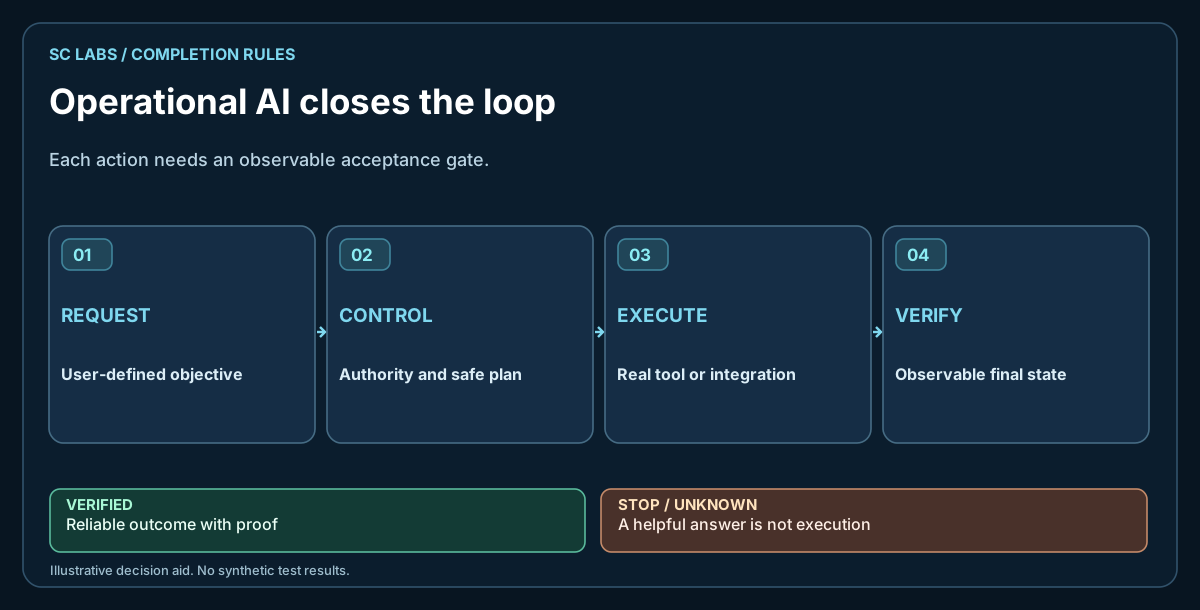
Chatbot → AI agent → operational AI
| Layer | What it usually does | What still may be missing |
|---|---|---|
| Chatbot | Answers questions and generates text, code or plans. | Real system access, tool execution, state verification. |
| AI agent | Plans steps and can call tools or APIs. | Durable operational boundaries, evidence, recovery and human authority may still be weak or implicit. |
| Operational AI | Uses controlled tools and real systems as part of an end-to-end workflow, verifies outcomes and returns evidence. | The exact capability remains limited by permissions, integrations, platform support and the maturity of the product. |
For the more detailed boundary between the last two rows, see AI Agent vs Operational AI: What’s the Difference?.
The important word is “operational”
The difference is not that the AI sounds more confident or produces a longer plan.
The difference is that the system can participate in the operation itself.
For example, a chatbot can explain how to organise a project folder. An operational system may be able to inspect the actual folder, identify files within an approved root, propose a plan, move permitted files, verify the resulting structure and show the human what changed.
A chatbot can explain how to test software. Operational AI may be able to inspect the repository, run the permitted test suite, read the output, compare it with the expected state and retain the evidence.
Operational AI needs more than a model
A capable model matters, but it is only the intelligence layer.
A practical operational system also needs:
- identity — which user, device or workspace is this action associated with?
- permissions — what is the system allowed to read, change or execute?
- tools — files, browser, APIs, terminal, applications, device capabilities or other bounded interfaces;
- state — what already happened and what is still unknown?
- verification — did the external system actually change as intended?
- recovery — what happens after a timeout, provider failure, denied permission or interrupted workflow?
- evidence — what can the human inspect afterwards?
- authority — which decisions remain human?
Our guide on testing AI agents properly treats these layers separately because a good model response cannot prove the rest of the system worked.
Human control is compatible with useful autonomy
Operational AI does not require a human to approve every harmless read operation. It also does not require giving an agent permanent unrestricted access.
The useful design space is between those extremes.
A system can be autonomous inside a bounded task while still requiring approval for sensitive operations. It can inspect a known workspace without being allowed to traverse the entire disk. It can prepare a change and ask before applying it. It can use a browser while keeping account, payment or disclosure decisions outside the automatic path.
The practical controls are described in How to Let AI Use a Computer Safely and the permission model in How Human-Controlled AI Should Handle Permissions.
Why verification matters
An AI saying “done” is not operational evidence.
If a file was supposed to be created, read it back or hash it. If software was supposed to build, compile it. If an API was supposed to update a record, inspect the resulting server state. If a UI action was supposed to change a setting, inspect the post-action state.
Operational AI becomes much more useful when the output is not merely a narrative about what probably happened.
Operational AI can use local or frontier models
The term does not imply one model strategy.
Some workflows benefit from a local model because privacy, latency, cost or offline operation matters. Other workflows benefit from frontier reasoning because the task is difficult or highly ambiguous.
The operational layer should ideally keep that model choice replaceable rather than making one provider the permanent architecture. The detailed routing trade-offs are in Local AI vs Frontier AI for Real Agent Work.
A practical example: ARKTOR
ARKTOR is the SC LABS implementation of this idea. It is designed to let AI use files, applications, browsers, terminals, computers and connected devices through explicit permissions while the human retains authority over consequential decisions.
Its public proof includes controlled Windows execution, modular capability paths, physical Android-device work and a vehicle-display Android extension. The detailed engineering evidence lives in SC Agent Lab, while the Engineering Journal records the decisions and failures that shaped the product.
This example is useful because it also illustrates an important boundary: “operational AI” is a product direction, not a claim that every possible application, platform and workflow is already supported.
How to evaluate an operational-AI claim
Ask these questions:
- What real system can it operate?
- Which actions are read-only and which can change state?
- How are permissions scoped?
- What requires human approval?
- How is success verified outside the model response?
- What happens after failure or interruption?
- Can you inspect evidence of the action?
- Is the model/provider replaceable?
- Which capabilities are proven on a real device or environment?
- Which claims are still roadmap, pilot or research?
The simplest definition
Operational AI is AI that can do controlled work on real systems — not only describe the work — while permissions, verification and human authority remain part of the system.