The wrong question is “which one is better?”
A local model can be the best choice for a private repetitive workflow and the wrong choice for a difficult ambiguous engineering task. A frontier model can be excellent at reasoning and still be the wrong dependency for a workflow that must continue offline or avoid sending sensitive data to an external provider.
The workload decides.
What changes when AI can act
For chat, model quality dominates the experience. For agents, model quality is only one layer. Provider health, tool calling, latency, permissions, state and recovery can matter just as much.
A strong remote model behind an unstable route may be less useful operationally than a smaller local model that is always available for bounded tasks. The reverse is also true: a local model that repeatedly misunderstands a difficult task can create more verification work than it saves.
Practical comparison
| Factor | Local AI | Frontier AI |
|---|---|---|
| Data path | Can keep inference on controlled hardware. | Usually requires sending context to an external service. |
| Availability | Independent of provider outages once installed. | Depends on network, provider and route health. |
| Reasoning ceiling | Depends heavily on hardware and model size. | Often strongest for difficult or ambiguous tasks. |
| Latency | Predictable but hardware-limited. | Can be fast, but network and queueing add variance. |
| Cost model | Hardware and power cost; no per-call provider charge. | Usage quotas or metered cost are common. |
| Offline use | Possible. | Generally not. |
| Operational control | High control over runtime and model version. | Provider may change routes, limits or availability. |
A useful hybrid pattern
Split the work by risk and difficulty instead of forcing one model to do everything:
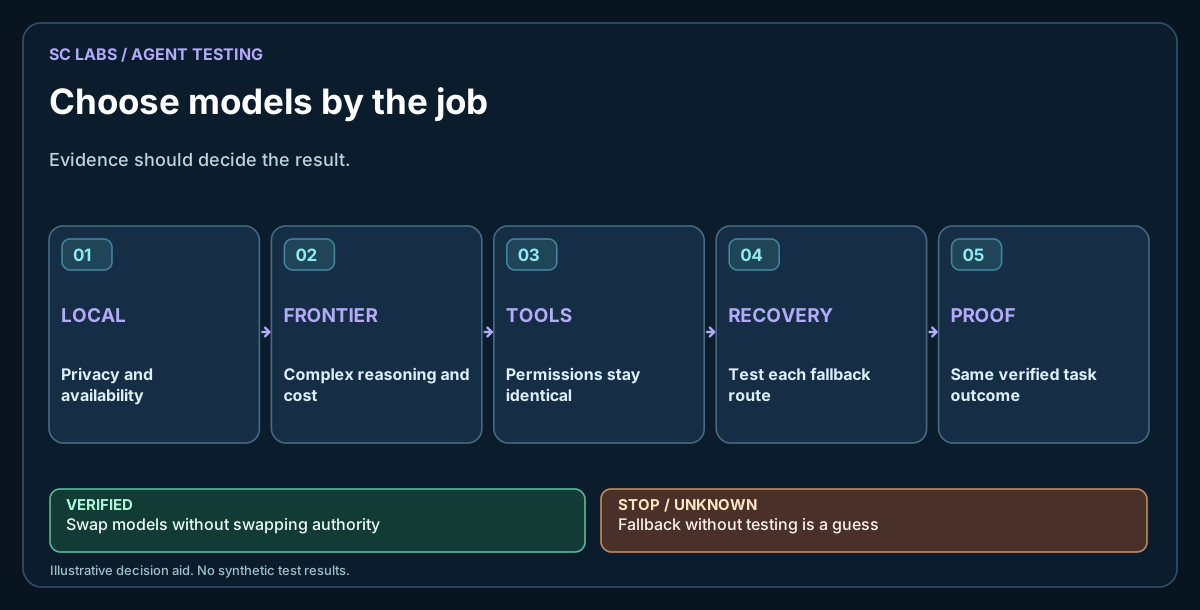
- Local baseline: classification, extraction, repetitive checks, private context and fallback.
- Frontier escalation: difficult reasoning, ambiguous code, complex planning or cases where the local verifier repeatedly fails.
- Operational layer: permissions, tools, state, verification and evidence remain stable regardless of which model is selected.
This keeps the intelligence source replaceable. It also lets a workflow degrade gracefully when a provider fails instead of collapsing completely.
Do not confuse model fallback with verified fallback
The small-model boundary guide explains when a local model should not make the final decision. A separate 27B end-to-end test shows why token speed and a credible plan do not themselves prove completion.
A fallback is only useful if it has been tested on the same task classes. Routing from a capable model to a smaller one may preserve availability while silently reducing correctness.
Our agent testing guide recommends scoring model capability separately from provider reliability so that a route change does not hide the reason a task failed.
Privacy needs a data-flow answer, not a label
“Local-first” does not mean every operation must stay local. It means local control is the default architectural position and external use is explicit. If a workflow escalates to a frontier provider, the user should know what context leaves the device and why.
See Local AI vs Cloud AI: What Stays Private? for the data-flow view.
How ARKTOR approaches the problem
ARKTOR is designed to keep the operational layer separate from the intelligence provider. That makes it possible to use local or external models without redefining the permission and evidence model every time the model changes.
Our Huawei provider-lab Journal article illustrates why this matters: the same endpoint exposed both strong model capability and route failures, while local baselines remained useful for a different deployment question.
What the current MCP/Secure Link proof adds
On 17 September 2026, SC LABS verified an isolated ARKTOR path in which a remote MCP request reached an approved local capability and returned independently checked evidence. Read, write and system-information requests completed through the same local permission and verification boundary.
That is stronger than saying a frontier model can call a tool. It shows that model access can stay separate from machine authority. The public Internet endpoint, production OAuth/provider onboarding and clean-PC release path are still separate gates, so this is not a claim that every cloud AI account can already control a PC through ARKTOR.
For the connection-path history and current boundary, see From Cloud Link to Sovereign.
A decision checklist
- Does sensitive context need to remain local?
- Must the workflow continue without internet access?
- How difficult is the reasoning step?
- Can the task be verified automatically?
- What happens if the provider returns 429, 5xx or an invalid payload?
- Is a local fallback actually proven on this task?
- Can the operational layer switch models without changing permissions?
The durable architecture is not “local” or “cloud”. It is a controlled workflow that can choose intelligence without losing its boundaries.