Step 1: define the job before choosing the model
Write down the real task classes the agent must perform: reasoning, code generation, file operations, structured data, browser actions, device control or long-running workflows. A benchmark should represent the job, not merely produce a convenient score.
Step 2: freeze a small reproducible suite
Use fixed prompts, expected outputs and scoring. Version the suite. If tasks change between runs, you are comparing stories rather than systems.
Step 3: score model capability separately
Measure whether the model can reason about the task or produce the required structure. Keep this separate from transport and tool failures.
If you are comparing local and external intelligence, keep the model result separate from route health. The guide Local AI vs Frontier AI for Real Agent Work explains why those are different operational questions.
Step 4: record the provider route
Store model and provider together. Record HTTP status, latency, empty responses, timeouts and rate limits. A provider failure should not silently become a model-quality failure — or disappear from the report.
Step 5: verify structured output
Use parsers, JSON Schema, type checks or exact contracts. Reject malformed tool arguments before execution.
Step 6: verify permission boundaries
Test both allowed and denied actions. A permission system is not proven if you only test requests that should succeed. Include attempts to write outside the workspace, run ungranted processes or access capabilities without consent.
For a practical permission model, see How Human-Controlled AI Should Handle Permissions.
Step 7: execute real tools against safe targets
Use isolated test repositories, synthetic files, local fixtures or a dedicated device. Confirm the external state after execution. A model saying “done” is not evidence.
Step 8: force failures
- return a tool error,
- disconnect the provider,
- send a 429 or timeout,
- remove a file between plan and execution,
- deny permission,
- return an HTTP 200 with invalid payload,
- interrupt a multi-step workflow.
Observe whether the agent stops, retries, changes route, asks for approval or corrupts state.
Step 9: test state transitions
Represent at least success, failed and unknown outcomes. For multi-step work, test continuation after interruption and ensure completed actions are not repeated blindly.
Step 10: repeat enough times to expose route instability
One pass proves a path exists. Repeated fixed runs reveal variance, provider instability and nondeterministic tool behaviour. The repetition count should match the risk and workload rather than an arbitrary universal number.
Step 11: use stronger verifiers as tasks get closer to production
For code, compile and run tests. For files, hash or read back. For APIs, validate the response and resulting server state. For UI, inspect the resulting state rather than assuming a click worked.
Step 12: publish the limitations
A useful negative example is our local 27B agent survival test: its scorecard recorded 10/15 checks, six output-length terminations and an autonomous failure. For a smaller build assignment, see the local LLM landing-page evaluation method.
State the device, app/build version, provider route, model identifier, task count, verifier and important missing gates. This prevents a narrow PASS from becoming an accidental universal claim.
A useful evidence record
| Field | Example evidence |
|---|---|
| Task ID | Stable identifier |
| Model | Exact identifier |
| Provider | Exact route |
| Model result | Pass / partial / fail |
| Provider result | Status, latency, error |
| Tool result | Exit/status + verified state |
| Permission result | Allowed/denied as expected |
| Recovery | Retry/fallback/stop |
| Artifact | Log, JSON or test output |
The SC LABS shorthand
For real agent tests we think in this chain:
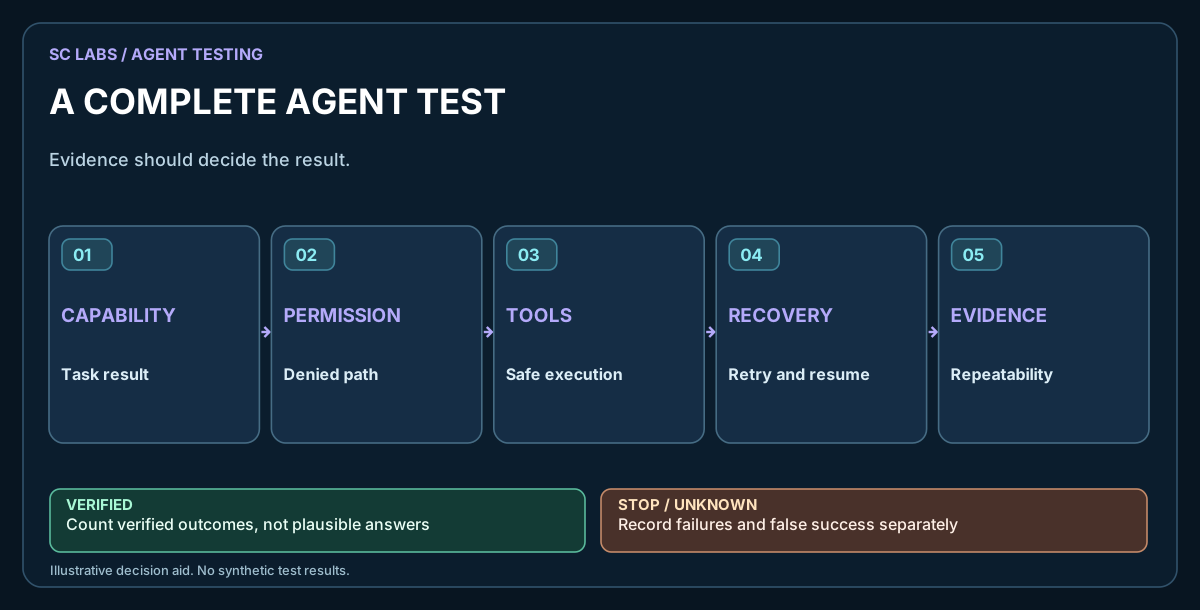
Prompt → Model → Provider → Permission → Tool → State → Verification → Recovery → Repeat.
If the report skips one of those layers, be careful about what the final score is allowed to claim.
The ARKTOR security-research stress test is a real example of why this matters: positive results, negative controls, reproduction and human decisions all belonged to the same workflow.
Want to test a real agent?
Define the task and acceptance criteria before evaluating a controlled pilot. A pilot starts with a scoped conversation, not a promise of public product availability.
Discuss a scoped ARKTOR pilot