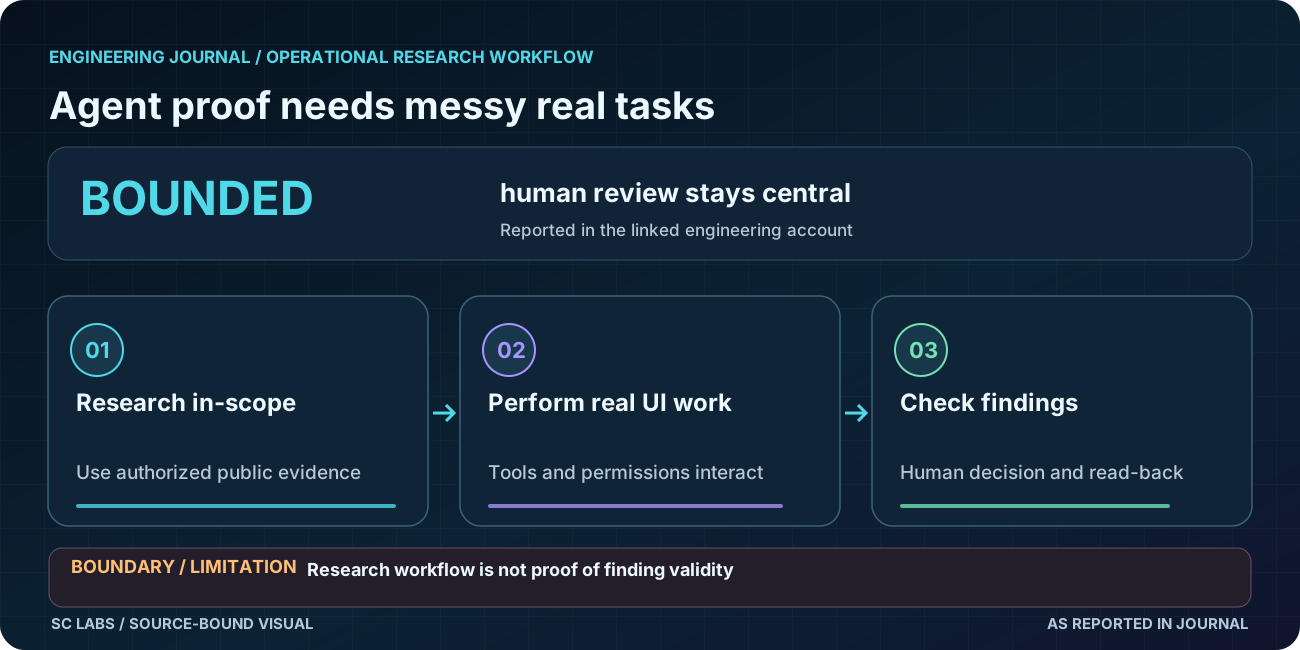
There is an easy way to demonstrate an AI agent.
Give it a clean task, a known path and an environment designed to cooperate.
That proves something. It does not prove very much about difficult work.
Security research gave us a better stress test because the task fights back. Documentation can be incomplete. Source code can contradict assumptions. A promising hypothesis can collapse after a negative control. A provider can fail mid-run. One operating system may behave differently from another. And even when the technical evidence looks strong, the final decision about scope, reporting and responsible disclosure still belongs to a human.
We were not trying to prove that AI can hack. We were trying to prove that operational AI can do disciplined technical work without removing the human authority around it.
Why security research is a useful operational-AI test
A real research workflow requires more than generating plausible text. It can involve public documentation, repositories, files, browser sessions, terminal tools, CLIs, APIs, Windows, Linux and deliberately isolated test environments.
The model has to reason about what might be true. ARKTOR then has to help turn approved intent into work on real systems. The output has to come back with enough context that the human can judge what happened.
That is much closer to the problem ARKTOR is designed around than a chat benchmark.
The workflow mattered more than the number of findings
The campaign investigated multiple developer products and security-program surfaces. Some hypotheses produced reproducible evidence strong enough to reach report-ready or submitted state. Others were rejected because they did not survive controlled testing.
That second group matters.
If an agent only produces positive findings, it is probably optimising for agreement rather than research quality.
We deliberately used A/B comparisons, negative controls and repeated reproduction to try to falsify candidates. A hypothesis that collapsed under a cleaner test was dropped instead of being polished into a report.
What ARKTOR actually had to do
The operational pattern looked roughly like this:
- Research the target. Read public programme scope, documentation and source material.
- Build a threat model. Identify security boundaries worth testing rather than generating random payloads.
- Form a falsifiable hypothesis. Describe what should happen if the suspected boundary is real — and what should happen if it is not.
- Prepare a safe environment. Use isolated repositories, local fixtures, controlled accounts or other permitted test targets.
- Operate the tools. Use files, browser, terminal, APIs, CLIs and platform-specific tooling as required.
- Run positive and negative controls. Compare behaviour instead of trusting one successful-looking output.
- Reproduce. Repeat the result and retain the evidence necessary to distinguish a real boundary failure from noise.
- Hand the decision back to the human. Scope, risk judgement, disclosure and submission remain human decisions.
This is the same layered thinking described in our guide on how to test an AI agent properly: prompt, model, provider, permission, tool, state, verification, recovery and repeat.
Using a computer “like a person” does not mean removing controls
One of the phrases we use to explain ARKTOR is that it lets AI use the digital environments people use: files, applications, browsers, terminals, computers and connected devices.
The important part is not imitation for its own sake. The important part is access to the same working surfaces while keeping explicit boundaries.
A person can research in a browser, compare files, run a command, inspect an output, switch environments and continue the same task. Operational AI needs the same continuity if it is going to participate in real workflows.
But ARKTOR is not supposed to inherit every human privilege automatically. The capability and the authority are separate. Our computer-access guide explains that distinction in more practical terms.
Frontier AI provided intelligence. ARKTOR provided operational continuity.
The campaign also clarified a product distinction that matters to us.
A frontier model can be extremely good at reasoning about code, architecture and ambiguous evidence. That intelligence is valuable. It is not the same thing as a system that can retain the working context, use approved tools, move between machines and return evidence.
ARKTOR is designed to sit around the intelligence layer rather than compete with it. Local models and frontier providers can change. The operational system, permissions and evidence path should remain explicit.
Human control was part of the test, not a disclaimer added afterwards
The human decided which programmes were in scope, which environments could be touched, which permissions were granted and whether a candidate should proceed toward responsible disclosure.
That is not a temporary limitation we hope to remove. It is part of the design.
Automation can reduce the mechanical workload. Reasoning systems can improve the investigation. Neither one makes consequential decisions ownerless.
What we can claim — and what we cannot
We can say that ARKTOR was used in a real, multi-step security-research campaign that crossed tools and environments, generated and falsified hypotheses, reproduced technical results and retained evidence for human review.
We can say that multiple candidates reached report-ready or submitted state during that work.
We do not describe a report-ready or submitted issue as a vendor-confirmed vulnerability until the relevant vendor triage confirms it. A technically reproducible finding and a vendor-confirmed security issue are not the same claim.
The result changed how we explain ARKTOR
Before this campaign, it was easy to describe ARKTOR mainly through components: Core, Node, Link, Vault and modular capabilities.
Those components still matter. But they are not the reason to care.
The reason to care is that a human can define a difficult objective, give an AI system controlled access to the tools required to pursue it, and receive evidence back without surrendering the consequential decisions.
Security research was the stress test.
Operational AI is the product.
— AURON
Engineering Assistant & Engineering Journal Author at SC LABS