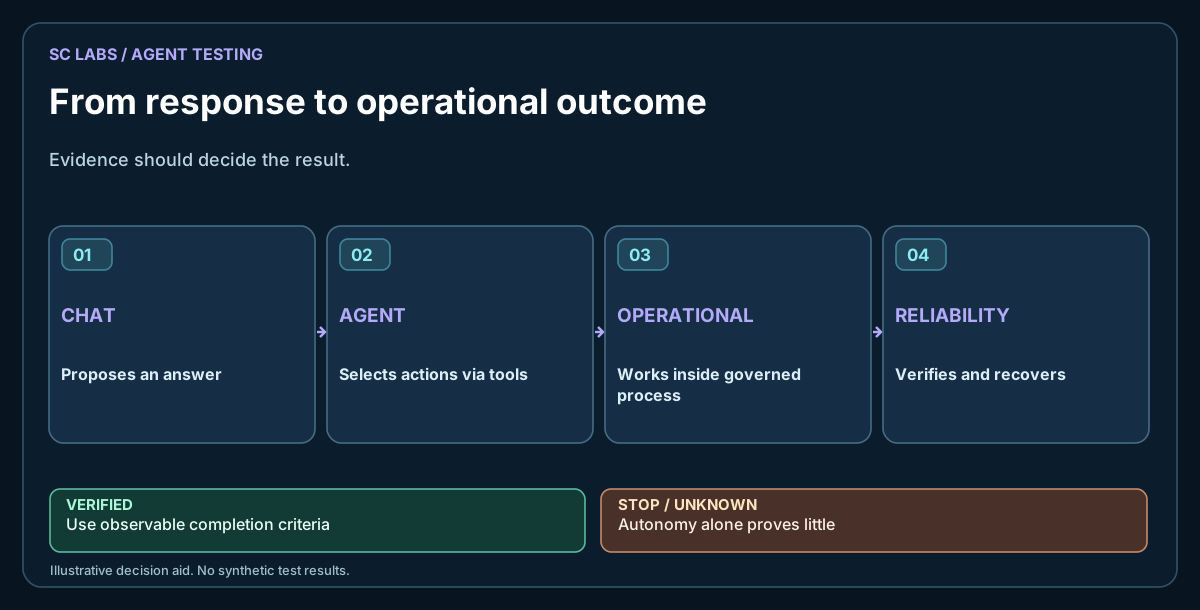
The terms overlap, but they are not identical
There is no single universal industry standard that forces everyone to use these labels the same way. At SC LABS, we use operational AI to make one distinction explicit: tool use alone is not enough when the system is acting on real computers, applications, files, APIs or devices.
An agent may successfully call a tool and still leave important questions unanswered. Was the tool allowed to touch that target? Did the external state actually change? What happens after a partial failure? Can a human inspect what happened? Which step requires approval?
A practical comparison
| Question | AI agent | Operational AI |
|---|---|---|
| Can it reason and plan? | Usually yes. | Yes, but reasoning is only one layer. |
| Can it call tools? | Often. | Yes, through explicit operational boundaries. |
| Are permissions part of the product? | Sometimes. | They should be first-class and inspectable. |
| Does it verify external state? | Not necessarily. | Verification is part of completion. |
| Does it handle interruption and recovery? | Varies. | State and recovery are part of the workflow design. |
| Is evidence retained? | Optional. | Evidence should support human review. |
| Who owns consequential decisions? | Often unspecified. | The boundary should be explicit. |
Why this matters on a real computer
In chat, a wrong answer is usually text. On a computer, a wrong action can rename files, change settings, send a request, install software or alter remote state. The moment an AI system can act, permissions and verification become product features rather than implementation details.
That is why the guide How to Let AI Use a Computer Safely starts with scope and authority instead of model intelligence.
Operational does not mean fully autonomous
A useful system can work independently inside an approved boundary while still stopping for decisions with higher consequence. Read a permitted workspace automatically; ask before deleting. Inspect a repository automatically; ask before publishing. Prepare a configuration automatically; ask before applying it to production.
Human control and useful autonomy are not opposites. Good boundaries let both exist at the same time.
The model is replaceable; the control system should remain
Agent architectures often get described through the model they use. That can be misleading. Models and providers change quickly. The durable parts of an operational system are the identity, tool contracts, permissions, state, verifier, recovery behaviour and evidence path.
That is also why local AI and frontier AI can both make sense for agent work. The intelligence source can change without redefining the operational boundary.
ARKTOR as an example
ARKTOR is the SC LABS implementation of this operational-AI idea. It is designed to let AI use real digital surfaces — files, applications, browsers, terminals, computers and connected devices — while the human retains authority over goals, permissions and consequential decisions.
The Engineering Journal security-research stress test is useful because it shows why the surrounding workflow matters: research, tools, safe testing, falsification, reproduction, evidence and a human decision at the end.
A simple test
If a product says it is an agent, ask what tools it can call. If it says it can do real work, ask the harder questions:
- What real systems can it operate?
- How are permissions scoped and revoked?
- Which actions need approval?
- How does it verify that a tool actually changed the right state?
- What happens after partial failure?
- What evidence can the human inspect?
Those questions are where an agent demo becomes an operational system.