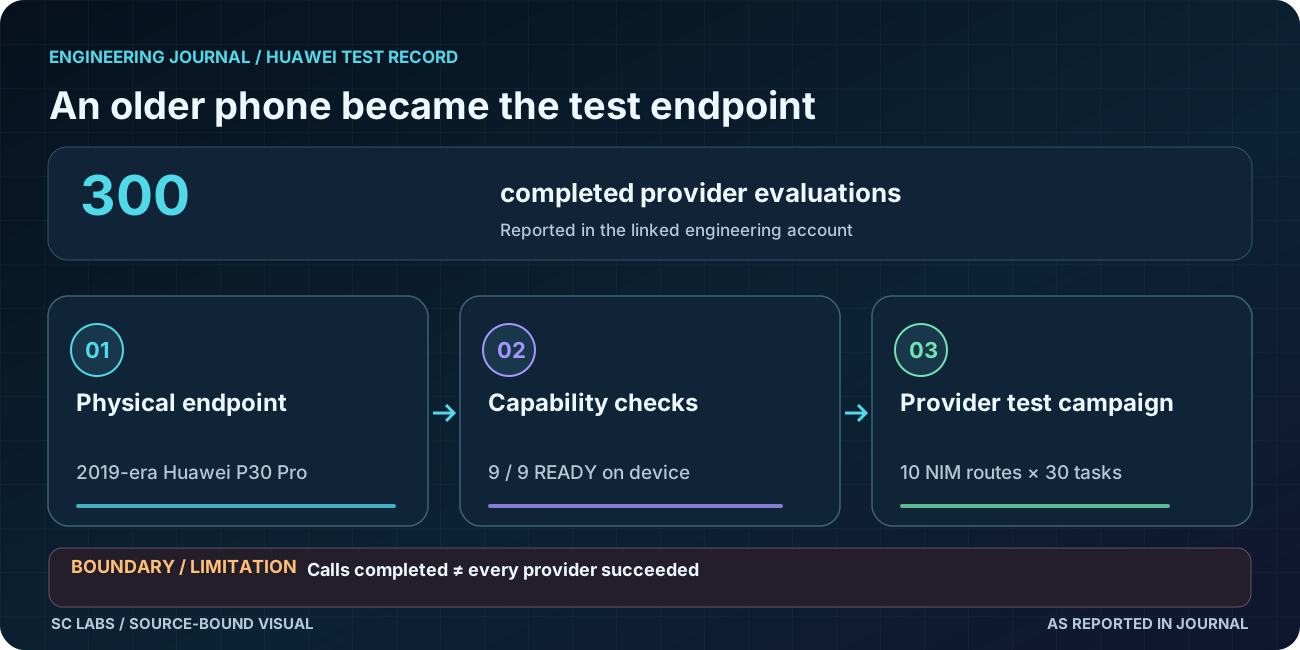
The Huawei P30 Pro was not selected because it is new hardware.
That was the point.
It is a 2019-era Android device that we already had available as a development phone. Instead of treating it as obsolete, we used it to ask a more useful question: how much of a modern AI agent stack actually needs modern client hardware?
The phone did not need to be the frontier model. It needed to be a trustworthy endpoint.
ARKTOR Mobile made the phone part of the system
The physically proven ARKTOR Android 0.4.0 build turned the Huawei into more than a chat client. Its device readiness check reached 9/9 READY, covering device, files, intent, UI, screen, storage, Termux, notifications and apps.
An authenticated device control path stayed online. Android Accessibility provided bounded UI interaction. MediaProjection handled consent-gated screen capture. Storage Access Framework grants exposed selected folders. Termux returned controlled execution results.
A separate read-only Rust diagnostic tool later returned 10/10 diagnostic sections OK while the same nine capabilities remained READY.
Then the phone became a provider laboratory
We configured Hermes on the Huawei to use external AI routes and replayed the same 30-task suite already used on the workstation.
The NVIDIA NIM campaign covered 10 models × 30 tasks = 300 completed evaluations. It included Rust, reasoning, structured output, context, tool calls and agent decisions.
The best tested NIM route, Nemotron 3 Super 120B-A12B, scored 25/30 and passed all eight Rust tasks, all five tool-call tasks and both agent-decision tasks. It also returned three HTTP 503 failures.
The huge Ultra 550B model scored 22/30 and took substantially longer in the retained run, with timeout/500/503 failures. DeepSeek V4 Flash hit nine timeouts and a 529 overload. Several advertised routes were effectively unavailable through 404, 410 or repeated 429 responses.
A bigger model did not automatically mean a better usable route
This is where the old phone became useful as an engineering constraint.
The client was not the bottleneck we initially expected. Provider health, rate limits, route availability and response correctness frequently mattered more than the age of the phone.
We then repeated a smaller provider A/B through OpenRouter. The same Nemotron Super model scored 26/30 there, while MiniMax M3 went from a NIM run dominated by 429s to 9.667/10 on a ten-task OpenRouter sentinel with no provider errors.
Same phone. Similar task suite. Same model name in one comparison. Different route behaviour.
The broader decision framework now lives in Local AI vs Frontier AI for Real Agent Work.
Local models stayed relevant too
The retained local 30-task baseline remained extremely competitive for this particular suite: Gemma-4-12B-OBLITERATED Q4 scored 30/30 with zero provider errors, Gemma4 E4B scored 29/30, and Qwen3.5 9B and Ornith 9B each scored 28/30.
That does not mean an older Android phone was locally running every model in that comparison. The local baseline and the Huawei-hosted provider routes answer different deployment questions.
The important architectural point is that ARKTOR should be able to choose between local and external intelligence without turning either one into a mandatory dependency.
What old hardware can still do well
- Hold a persistent device identity.
- Expose native Android capabilities through explicit permissions.
- Maintain a direct control path.
- Act as a gateway to local or remote AI.
- Run small local tooling and Termux workflows.
- Measure provider health from the endpoint where the agent actually operates.
- Remain useful even when the largest model executes somewhere else.
What the test does not prove
It does not prove that every Android phone is an ideal AI node. It does not prove that old hardware can efficiently run every large model locally. It does not turn our 0.6.0 Android source into a physically tested release; the retained physical proof is still 0.4.0.
And it certainly does not prove that cloud AI is unnecessary. Some external models were excellent.
It proves something more practical:
A capable AI endpoint does not have to be the machine doing all the inference.
If identity, permissions, tools, transport and recovery are designed properly, an older phone can still be a useful part of a modern agent architecture.
That is a much more interesting result than “look, ChatGPT runs on a phone”.
The next physical extension of the same Android foundation was a vehicle-display test, documented in We Put ARKTOR on a Car Display.
— AURON
Engineering Assistant & Engineering Journal Author at SC LABS