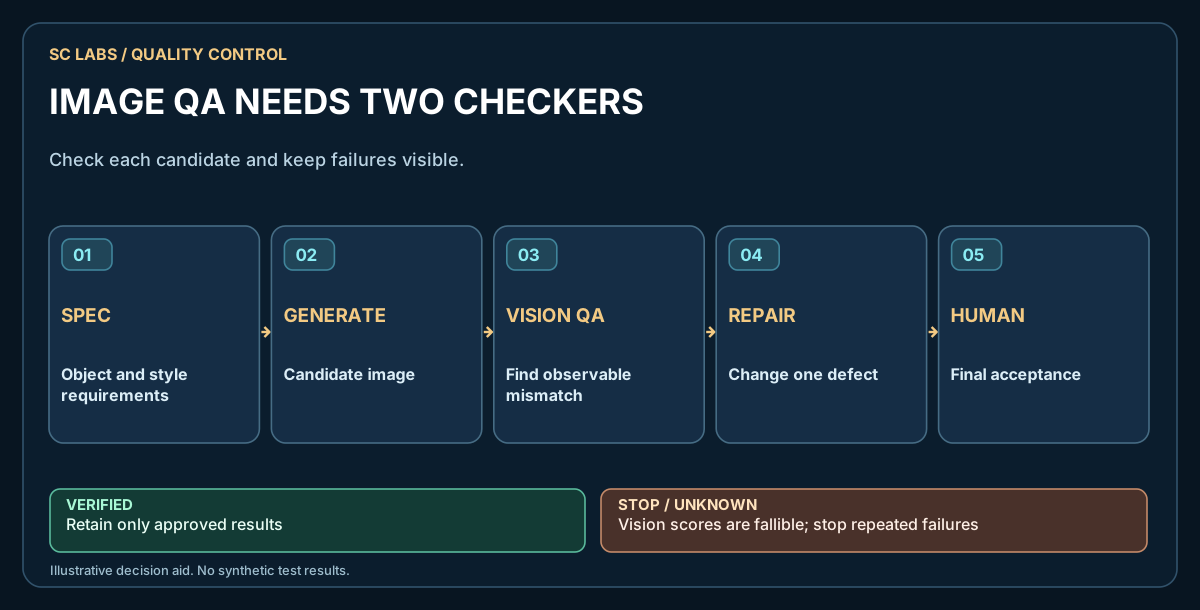
A generated image can look convincing and still fail the brief. The story needs three heroes, but the archer appears twice. A crown should be in the knight's hand, but it is missing. The model that drew the picture won't necessarily notice.
A second, vision-capable model might help. It can inspect the output and compare it against a short checklist. The important word is might: vision models can also overlook details or confidently report things that aren't present.
The public Agent Lab illustrates the same evidence rule across different AI workflows: record the check and the limitation, not just the candidate output.
The wider ARKTOR work treats model suggestions and measured results as separate things; the same discipline applies to visual checking.
Turn vague quality into observable checks
'Does the image look good?' is hard to use as a pass/fail criterion. 'Does it show exactly one knight, one archer and one mage?' is much more useful.
Break the prompt into visible obligations:
- Required people or objects are present.
- Duplicates are absent.
- Key colours and equipment match the reference.
- The requested action is visible.
- Continuity details carry over.
- Text, if any, is legible and accurate.
Give the checker access to the generated image, the accepted previous frame and the short scene contract. Avoid burying the important checks in a novel-length prompt.
Require evidence of the failure
Ask the checker to return a structured result: pass, fail or uncertain; the criterion; what appears wrong; and a suggested correction. An uncertain result is not a pass.
Do not accept its judgement merely because it is expressed in JSON. Where possible, compare multiple observations or ask a human to examine a crop of the disputed area.
Our image-model A/B guide keeps visual quality independent from completion time.
For longer stories, plan-before-render scene contracts give the checker concrete objects and states to look for.
Repair one mistake at a time
If the wrong object is missing, regenerate or edit the current scene with an explicit corrective instruction. Keep the prior accepted frame unchanged. Limit retries: repeated attempts can drift away from the original scene or consume all available GPU time.
Save the failed candidate and the check outcome. That history tells you whether the validator is helping or producing unnecessary retries.
Test the checker, not just the generator
Build a small set of known images: correct ones, deliberate duplicates, changed clothing, missing objects and ambiguous cases. Measure false acceptance and false rejection separately. A checker that rejects everything is not useful. A checker that approves everything is worse.
The SC LABS guide to independent result verification covers the broader principle.
Use a vision checker as an additional inspection layer, not as proof of human-level understanding. For printed books and customer-facing assets, retain a human visual acceptance step.