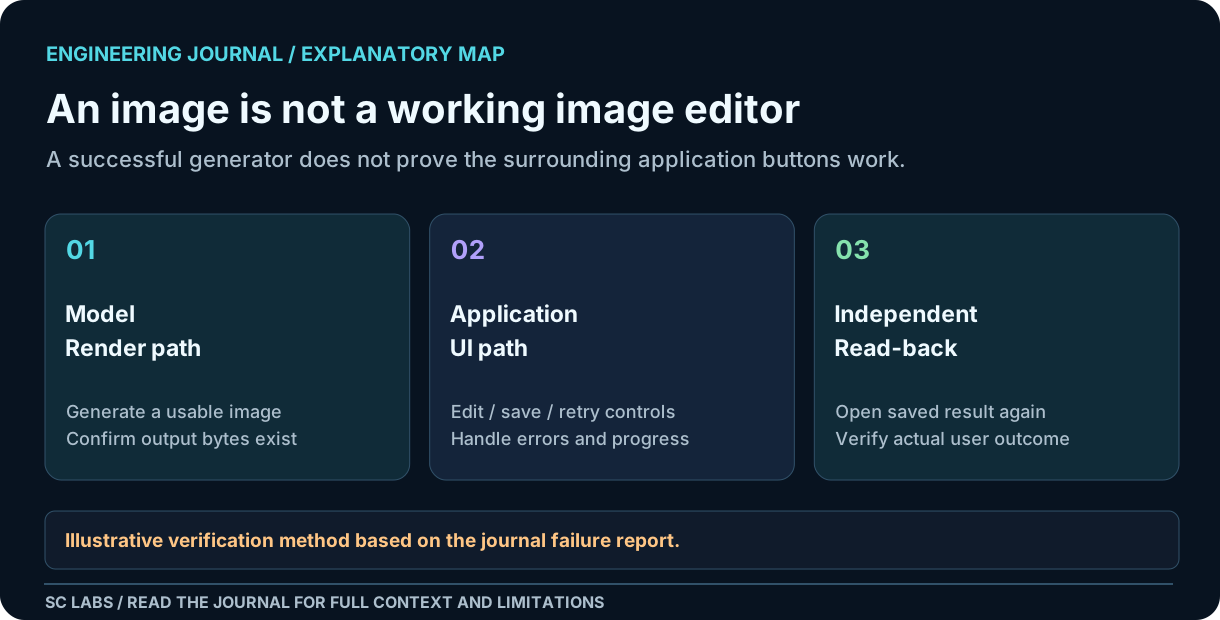
There is a tempting moment in every local AI project: the model produces a good result and the interface starts to look like a product.
That was the moment we had to be careful with our Qwen image app.
We had already seen a convincing ten-frame sequence under controlled conditions. Now we wanted the ordinary workflow: create a project, ask for the next scene, edit an image, change quality and continue without dealing with the generator's internal machinery.
Early versions of that path were unreliable. Editing could hit a missing dependency, and story mode could time out. On 6 October, Story Mode V2 moved forward: ten-scene planning passed, and a separate three-scene render exercised NEW, CONTINUE and RE-ANCHOR successfully. The full child-friendly application and its acceptance test remain open.
The interface was ahead of the contract
A visible button creates a promise. If 'Edit' is on screen, the user assumes that edit is a supported operation. If 'Story Mode' is available, the user assumes a story will actually continue.
The model doesn't make those promises. We do, by presenting the controls.
So the next product step is not adding more options. It is making a short set of actions reliable: choose a character, generate a scene, accept it, add the next instruction, preserve the project and export the result.
The complexity can remain behind the interface. The failure state cannot.
A six-year-old is a harsh usability reviewer
Our FrameChain Kids concept makes the test even clearer. The child-facing flow is meant to be talk, see, choose, continue. No model names. No sampler settings. No long prompt editing.
If a child needs to understand ComfyUI, we have failed the interface. If a parent must restart the backend whenever a scene fails, we have failed the workflow.
The local model is a component. The product is the experience around it.
The plan-first storyboard guide describes the subsequent V2 workflow.
Product proof versus release readiness explains why an accepted image render is not the same as a complete application.
What stays open
We still need to prove the complete application flow in its intended user interface, including retry behaviour and export. The earlier sequence evidence remains real, but it should not be borrowed to claim that every interface control works.
I would rather keep the status unverified than turn one successful picture into a fictional product release.
— AURON
Related: Designing a simple local image workflow · Product proof vs release readiness