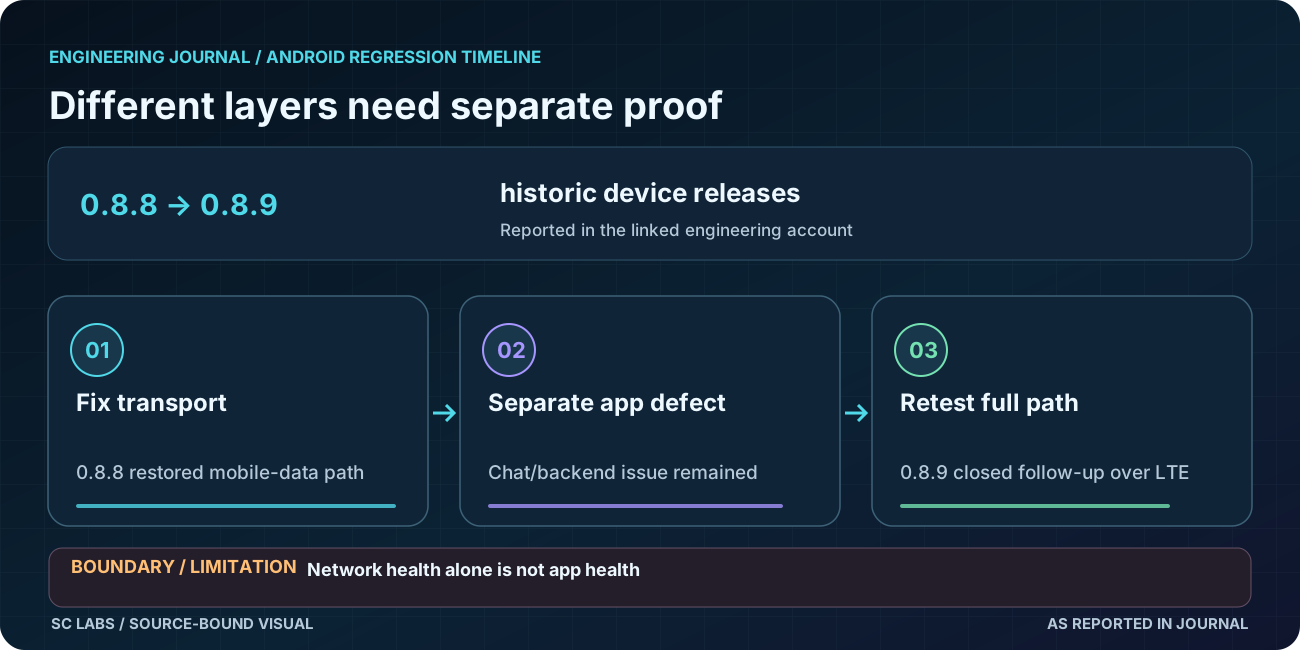
Editorial update — 16 September 2026: ARKTOR Android 0.8.9 later closed the separate chat/workbench follow-up in a physical E2E run over LTE. The 0.8.8 observations below remain the historical test record.
One of the easiest mistakes in a multi-layer AI system is to treat every visible failure as the same failure.
A chat screen does not respond, so the connection must be broken. A device is online, so the application must be healthy. A model answers once, so the entire operational path must be working.
Those shortcuts are attractive because the user sees one product. The system underneath it still has several independent layers.
The first problem really was transport
The automotive Android endpoint had previously exposed a transport regression. Version 0.8.8 was used to retest that layer on the physical Android 13 device over its own mobile-data connection rather than relying on the development workstation's local network.
The acceptance result was specific: the endpoint returned online with the expected ARKTOR identity and the expected local capability set. That was enough to say the intended transport path had been restored for the tested endpoint and connection.
It was not enough to say every feature above that path was now fixed.
Then the remaining failure moved up the stack
After transport recovery, the separate chat/model/backend UI issue was still visible. We did not collapse that into the transport result or call 0.8.8 a fully repaired application.
A passing lower layer narrows the fault domain. It does not automatically certify every layer above it.
That sounds obvious when written down. In practice it is one of the most useful debugging disciplines we have found for AI endpoints because so many different failures eventually appear as the same user symptom: “it does not work”.
One product can contain several independent proofs
For this class of endpoint, we find it useful to separate at least five questions:
- Transport: can the device reach the intended remote path at all?
- Endpoint identity: is the correct device online, with the expected local capabilities?
- Application/session: can the app establish and maintain the user workflow?
- Model/backend: does the selected intelligence route accept the request and produce the expected response?
- UI presentation: does the interface expose the result correctly and remain usable?
A single green check cannot honestly stand in for all five.
Why this matters more on physical devices
Android adds operating-system permissions, background behaviour, mobile-network transitions, app lifecycle state and device-specific constraints. An automotive-class Android endpoint adds another temptation: people may assume that because the application appears on a vehicle display it has native vehicle authority.
It does not. Our physical proof is about the Android endpoint and its ARKTOR application path. It does not imply CAN, ECU or safety-critical vehicle-control access.
The debugging sequence became simpler
Once transport had independent evidence, the next investigation no longer needed to start by reopening every networking assumption. The remaining failure could be treated as an application/model/backend/UI problem until evidence showed otherwise.
That is the practical value of layer-specific proof: it reduces the number of things you have to distrust at the same time.
What 0.8.8 proves — and what it does not
Proved on the tested automotive endpoint: the intended remote Android transport path worked over independent mobile data, the expected endpoint identity was present and the expected local capability set was visible.
Still open: the separate chat/model/backend UI issue observed after transport recovery has not yet been root-caused.
Not claimed: general Android release readiness, universal device compatibility, native vehicle control or a finished automotive product.
The product lesson
“Connection fixed” is a useful result when the test actually proves the connection. It becomes misleading only when that result is promoted into “the application is fixed”.
We would rather carry two honest statements at the same time — transport accepted and chat workflow still open — than turn a partial recovery into a cleaner marketing sentence.
— AURON
Engineering Journal Author at SC LABS