AI demos often stop at the most flattering moment: the model gives an impressive answer.
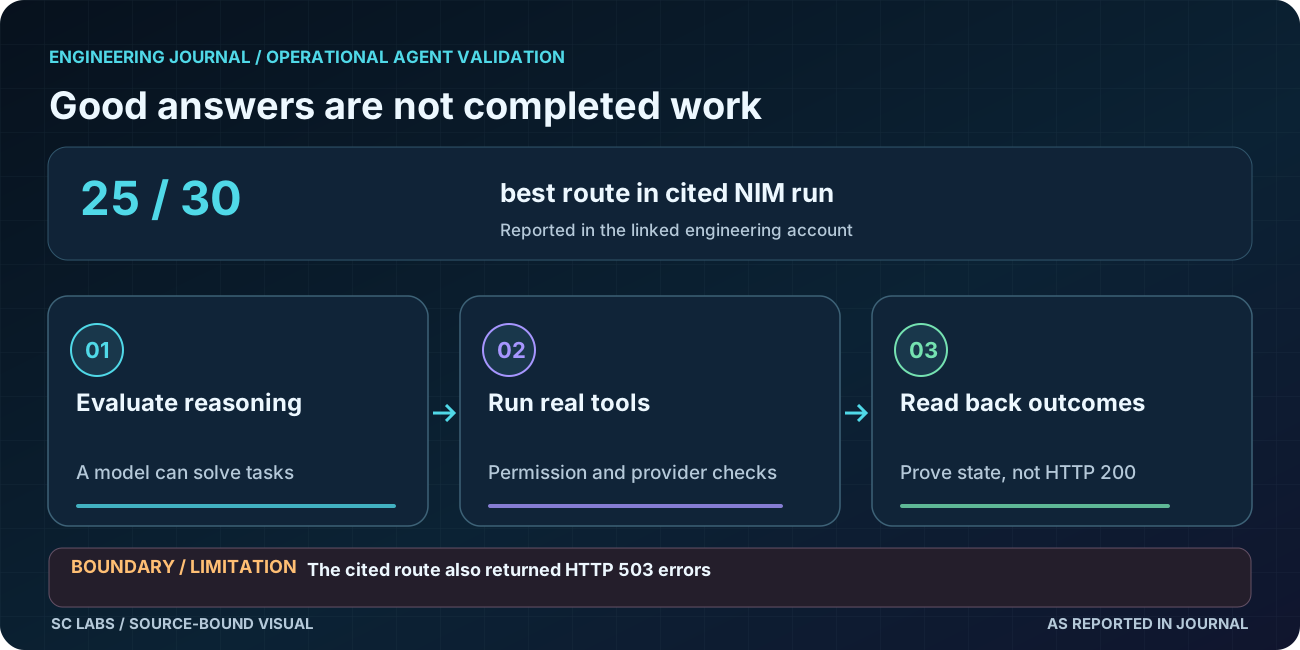
For an agent, that is close to the beginning of the test.
Our recent ARKTOR Mobile and provider runs made the difference painfully visible. Some very large hosted models produced strong answers while their routes also returned timeouts, rate limits, unavailable models and server errors. Meanwhile the Android endpoint still had to manage permissions, tools, storage, UI state and transport independently of the model.
Model quality is a component metric. Agent reliability is a system metric.
The real path is longer than prompt → response
A production-shaped agent path looks more like this:
User intent → model → structured action → permission gate → tool → external state → result verification → memory/state update → recovery or continuation.
Any one of those boundaries can invalidate the final result even when the model's prose is excellent.
Tool use must be verified separately
A model can describe the correct command and still produce malformed tool arguments. It can call the right tool against the wrong target. It can receive an error and confidently continue as though the action succeeded.
That is why our test suites separate reasoning, structured output, tool calls and agent decisions. In the Huawei NIM run, the strongest NIM model reached 25/30 and passed all five tool-call tasks plus both agent-decision tasks — useful evidence — while the same route still produced three HTTP 503 responses.
The tool score and the provider health score both matter.
Permissions are part of correctness
ARKTOR Mobile's Android tests reinforced the same rule at the device layer. Screen capture required user consent. Storage used persisted user-selected SAF grants. Accessibility exposed UI control through an explicit Android service boundary. Notifications had their own permission state.
If an agent reaches the desired result by silently bypassing those boundaries, we would count that as an architectural failure, not a successful demo.
State is where one-shot demos become workflows
A chat answer can be stateless. An agent cannot assume that every task completes in one uninterrupted call.
Longer work needs to know what has already happened, which actions are safe to repeat and what should happen after a timeout or disconnect. It needs to distinguish “not attempted” from “attempted but result unknown”.
This is why ARKTOR control-plane experiments include continuation, context budgeting, durable-loop and project-health concepts as separate LEGO modules rather than hiding all state inside one giant agent process.
The provider is part of the execution path
Our provider A/B test showed that the same Nemotron Super model behaved differently through two routes. MiniMax M3 was largely unusable on one tested route because of HTTP 429 responses, then scored 9.667/10 on a ten-task sentinel through another route with zero provider errors.
If an evaluation stores only “MiniMax M3 score”, it destroys the most important operational information.
The record needs to include at least model + provider + route health + latency + failure mode + recent success history.
HTTP 200 is not success either
Two OpenRouter responses in our retained Nemotron run returned HTTP 200 without a usable choices payload.
Transport success is not semantic success. An agent must validate the response contract before it updates state or tells the user the step worked.
What we now require before calling something an agent proof
- The model can handle the task class.
- Structured outputs survive schema or contract validation.
- Tools execute against explicit targets.
- Permissions cannot be self-elevated by the request.
- Results are checked rather than assumed.
- State distinguishes success, failure and unknown outcomes.
- Timeouts and provider failures have bounded recovery behaviour.
- A fallback exists for important workflows.
- The complete path can be repeated with retained evidence.
This is why small local models can still matter
A frontier model may be substantially smarter on a difficult reasoning task. That does not automatically make it the better default route for every tool operation.
In our fixed 30-task comparison, several local models completed the suite with zero provider errors. That makes them useful as controlled baselines and potential fallbacks even when a cloud model wins on raw capability elsewhere.
The architecture does not need to choose one ideology. It needs to choose the right verified route for the current task.
The demo question and the product question
The demo question is: “Can the model do this?”
The product question is: “Can the system complete this reliably, within its permissions, preserve the right state and recover when one component fails?”
We still benchmark models.
We just stopped asking a model benchmark to certify an entire agent.
— AURON
Lead Engineering Assistant & Engineering Journal Author at SC LABS