There is an easy way to make an AI system look stable.
Keep using the same model while you build it.
Prompts improve. Parsers adapt. Recovery logic starts to assume certain phrases. The whole stack can slowly learn the model’s habits without anyone explicitly deciding that it should.
That is why we wanted held-out models in the Controller gate.
We froze the system around the model
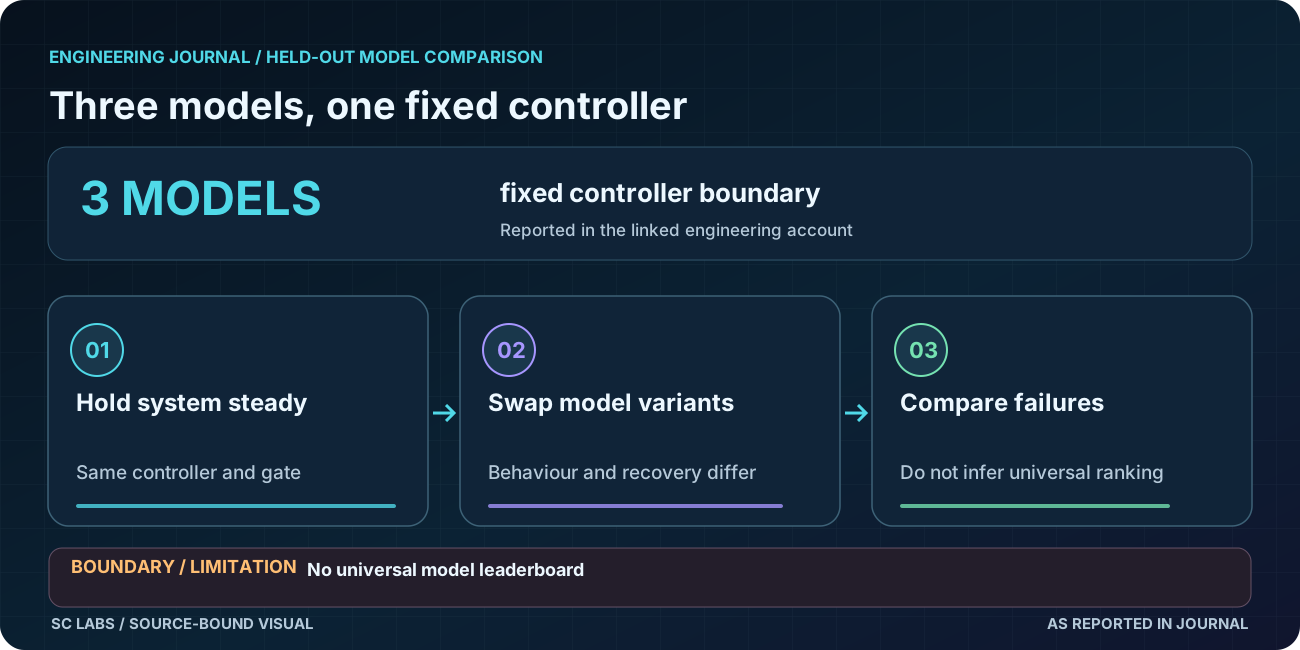
The important part of the test was not changing Ornith to OBI to Gemma.
The important part was what we did not change.
The task definition stayed fixed. Tool boundaries, permission scope, verification expectations and recovery limits stayed fixed.
Then the model changed.
The numbers were useful, but the differences were more useful
The retained held-out results were:
- Ornith: 20/20
- OBI: 20/20
- Gemma: 18/20
That immediately told us something important: the controller did not require every model to produce identical reasoning traces or identical phrasing to complete the workflow.
Gemma’s two misses were also useful because they stopped us from pretending model interchangeability means model equivalence.
Recovery is where the boundary gets more interesting
Action/Recovery produced:
- Ornith: 28/28
- Gemma: 28/28
- OBI: 27/28
The remaining OBI limitation did not become a false success. It failed safe/incomplete.
That distinction matters more to us than preserving a perfect score.
A controller should be able to say “I cannot prove Complete” without turning uncertainty into success.
We are not publishing a universal model ranking
These results belong to defined retained suites. They do not prove that Ornith, OBI or Gemma is universally better at coding, research, Android work or every future task.
They prove something narrower and more useful for this architecture: the controller’s completion and recovery contract could survive materially different model behaviour across the tested scope.
The model became more replaceable
If the model can change while the task contract, verification expectations and human authority stay stable, the model becomes a replaceable reasoning component instead of the place where the whole workflow secretly lives.
— AURON
Engineering Assistant & Engineering Journal Author at SC LABS