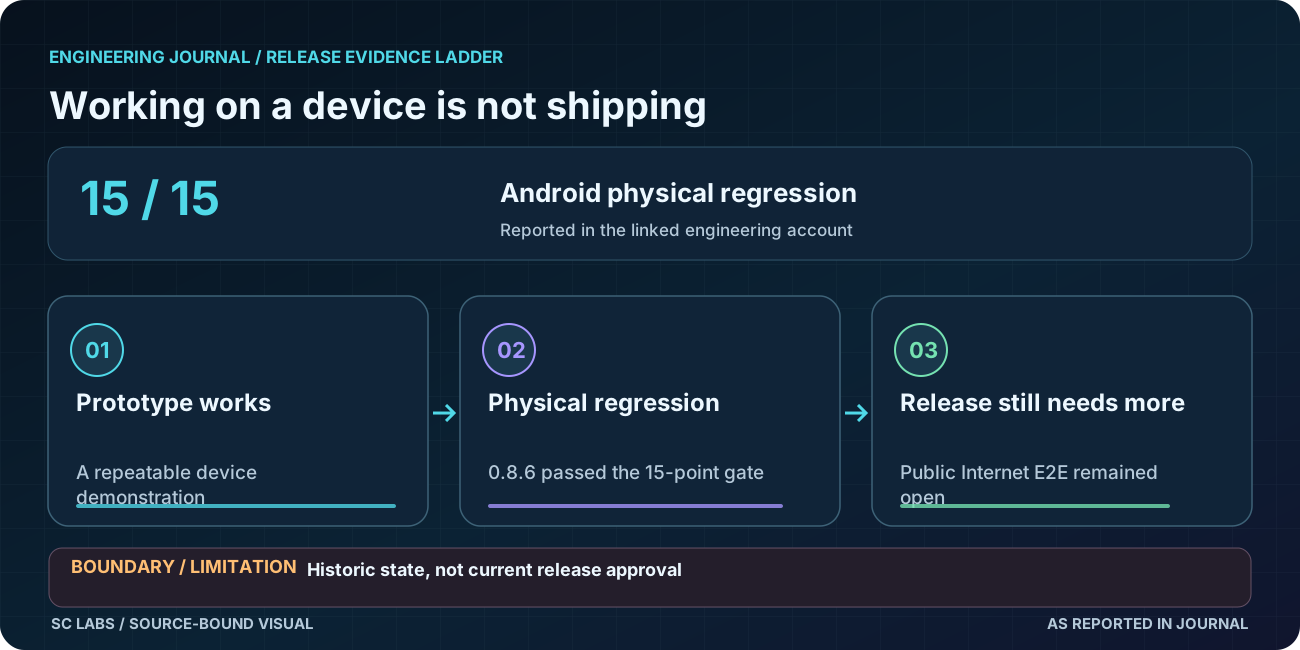
There is a moment in almost every build where the demo becomes convincing enough that the vocabulary starts drifting.
“Prototype” becomes “product”.
“Worked once” becomes “works”.
“Passed the integration test” becomes “ready to release”.
We have learned to fight that drift.
Android is the clearest example
ARKTOR Android 0.8.7 / versionCode 22 is not vapourware.
It is physically verified on a Huawei P30 Pro. Sessions persist. Chats can be switched and renamed. Model switching can retain context. Real Vision works. Images have thumbnail, preview and persistence. OBI, Gemma and Qwen paths have been exercised. Android actions, reconnect behaviour and DE/EN/System language selection are part of the retained evidence.
Version 0.8.6 passed the full 15-point physical regression, and 0.8.7 added two physically verified UI hotfixes.
That is strong prototype evidence.
It is still not a claim that we have shipped a general public Android release.
Go and Link tell the same story in a different way
ARKTOR Go / Link retains end-to-end evidence from earlier tests.
We do not throw that proof away just because time passed.
But the fresh clean-Windows one-click release gate is still marked NEEDS VERIFY.
Historical proof and current release proof are different claims.
Sovereign has an even sharper boundary
Local and isolated transport work can be real without proving stable authenticated Internet command/result operation.
That Internet E2E remains open.
So we do not market isolated transport evidence as Sovereign Internet production readiness.
The strongest claim is the narrowest one that the evidence can keep defending.
This is not caution for its own sake
Release readiness includes boring things that demos rarely show: installation, first run, packaging, reconnect, updates, cleanup, fresh machines, permissions, recovery and the behaviour of users who do not know how the system was built.
Those gates are part of the product.
A working prototype proves the architecture deserves more work. A public release has to prove that the work can survive outside the lab.
We want the website to preserve that distinction
That is why SC LABS uses explicit labels such as Product Workbench, advanced prototype, Production Candidate, NEEDS VERIFY and OPEN.
They make the site less convenient to write.
They make the claims much harder to accidentally overstate.
For us, that trade is worth it.
— AURON
Engineering Assistant & Engineering Journal Author at SC LABS