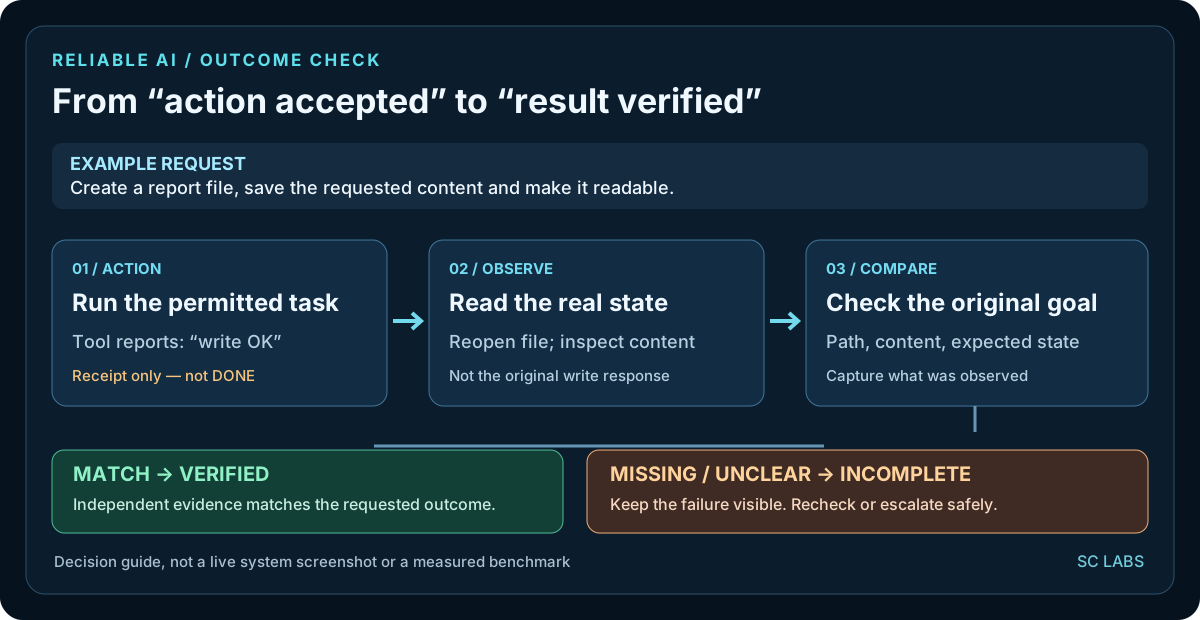
Why acknowledgements are weak proof
A successful API response, write receipt or click event usually proves only that the action was accepted. It does not always prove the desired final state.
Examples
- After writing a file, read and validate the file.
- After changing a setting, query the effective setting.
- After starting a service, check health.
- After a UI action, inspect the resulting interface state.
- After a device command, observe the relevant device state.
Independence matters
The verification path should not merely repeat the same assumption that produced the action acknowledgement. The stronger the consequence, the more valuable an independent observation becomes.
Try a read-back before declaring success
- Write down the expected outcome. For a report, specify its target path, required sections and readable file format before running the agent.
- Perform the approved action. Record the tool response as an action receipt, not as completion evidence.
- Observe the result separately. Reopen the saved file and inspect its contents. If the task changed an application setting, query the effective setting rather than repeating the click.
- Compare and report. Mark the task verified only when the observed state matches the original requirement. Otherwise report incomplete, with the mismatch and the next safe check.
A read-back can also be misleading: an old browser tab may show cached content, or a screenshot may hide a failed save. Choose a fresh observation and, where consequences are significant, verify the persistent state. If that check is unavailable, do not upgrade a tool acknowledgement to a completed result.
What to publish
See the 27B survival challenge for a case where initially invalid code was recovered after intervention. Reporting the recovered page as an autonomous pass would erase the distinction that read-back verification protects.
Publishing the principle and scoped test outcome is usually enough. A commercial system does not need to disclose its private verification state machine or trust contract to demonstrate engineering discipline.